




GLOBE Cup Challenge - GLOBE Observer



GLOBE Cup Challenge
This challenge has concluded - see the results!
During the World Cup, from 11 June to 19 July 2026, join the GLOBE Program in collecting environmental data where the world plays soccer (football)!
Go to your local soccer (football) field, park, schoolyard, or anywhere people play, and take observations:
Whether you play soccer (football), cheer from the sidelines, coach a team, or simply live near a field, you can help investigate the environment where soccer (football) is played in your community. Is the field surrounded by trees, buildings, dirt, or pavement? Is it grass, artificial turf, or another surface? How do temperatures compare from one day to the next — and how does your local field compare to fields around the world? How does your field compare to the surrounding areas?
World Cup athletes will compete on cultivated grass fields in a wide range of environmental conditions. Your observations can help us explore how playing environments differ across regions, climates, and field surfaces.
How to Participate
To participate, join the GLOBE Team in your region (listed below) and submit complete observations throughout the challenge. Let’s see which GLOBE region is the biggest soccer (football) fan! We’ll track participation around the world and highlight observations and soccer (football) fields from different GLOBE regions.
Every observation counts! Join and participate any time during the Challenge. Participants who join a regional team and submit a land cover, air temperature, or surface temperature observation during the challenge will receive a certificate.
Bonus: Include your soccer ball (football) in your “Down Photo” so we can see where the world plays!
|
|
|
Regional GLOBE Teams (join one):
- Africa: GLOBE Cup Africa
- Asia and Pacific: GLOBE Cup Asia Pacific
- Europe and Eurasia: GLOBE Cup Europe Eurasia
- Latin America and Caribbean: GLOBE Cup LAC
- North America: GLOBE Cup North America
- Near East and North Africa: GLOBE Cup NENA
Not sure how to join? Learn more about GLOBE Teams.
Tips and Resources
Land Cover
Tips
- Watch this video for how to get started!
- Using the Land Cover tool in the GLOBE Observer app, photograph the land cover in your surroundings, focusing on the area within the nearest 50 meters or about the size of half a soccer field (required)
- Identify the correct land cover classification using this visual
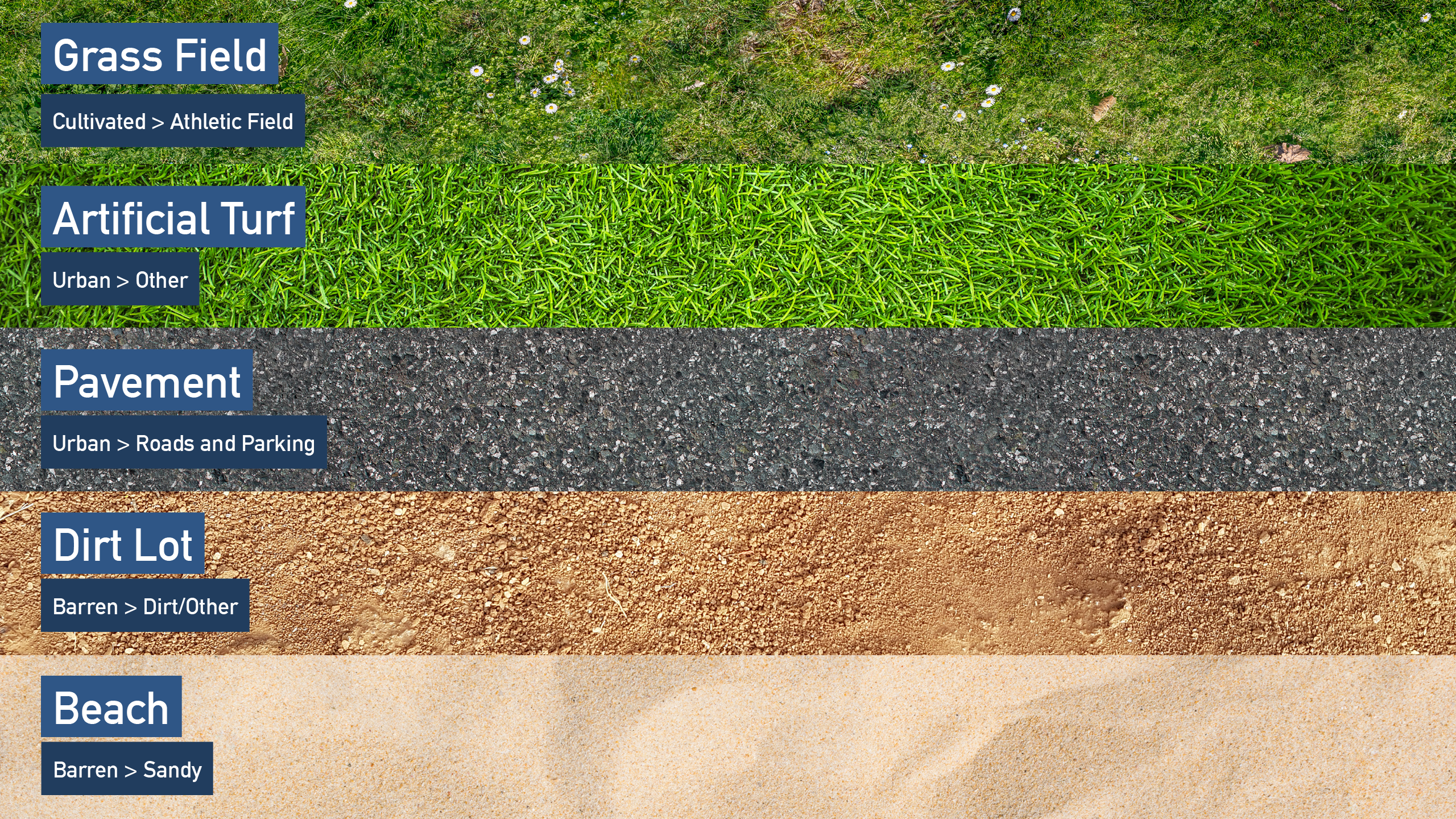
Air Temperature
Get Trained
Training options include (complete one of the three):
- Read through the Field Guide
- Complete the data collection eTraining (recommended for citizen scientists, requires account creation if first time using training system)
- Complete the protocol eTraining (recommended for educators, requires GLOBE account)
Tips
- When using an alcohol-filled or meat thermometer, make sure your thermometer is calibrated! Learn how to calibrate a thermometer.
- Take the measurement in the shade (could be the shadow of your body)
- Wait a minute to see if the temperature changes – keep checking until the temperature does not change
Surface Temperature
Get Trained
Training options include (complete one of the three):
- Read through the Field Guide
- Complete the data collection eTraining recommended for citizen scientists, requires account creation if first time using training system)
- Complete the protocol eTraining (recommended for educators, requires GLOBE account)
Tips
- Use an Infrared Thermometer
- Leave the Infrared Thermometer outside for 1 hour if the outdoor temperature is very different than the indoor temperature.
- Do not take the temperature of shadowed areas (including the shadow that your body may cast).
- Extend your arm in front of you to take the observations. (You don’t want to measure the temperature of your feet.)
- Be sure to take 3 - 9 random surface temperature readings within the homogeneous area.
- Be careful to not mix cover types (grass, sand, pavement) in one study area.
Good luck to the World Cup athletes (and fans) of the 48 teams competing in the FIFA World Cup 2026!
Watch the video of the June GLOBE Observer Connect kicking off the event:
Which GLOBE team won the GLOBE Cup Challenge? We will announce the results and recognize the winning teams on July 30 at 12 pm ET (16:00 UTC). Dr. Eric Brown de Colstoun from NASA Goddard Space Flight Center and Dr. Kevin Czajkowski from University of Toledo will share highlights from the data submitted and be available to answer questions. Come share what you learned during the challenge. Register here.